
May 2026
There’s something magical about standing in front of ancient rock writings and realizing you’re looking at images left behind hundreds—sometimes thousands—of years ago. This spring, Nevadans for Cultural Preservation (NVFCP) had the incredible opportunity to help preserve that history at Little Red Rock alongside Knight and Leavitt Associates.
Our mission? Update archaeological records for the site and carefully document every pictograph and petroglyph we can find.
That might sound simple until you’re hiking across rugged terrain with cameras, drones, GPS equipment, and notebooks while chasing the perfect sunlight angle for photography. Archaeology, it turns out, is part science, part art, and part adventure.
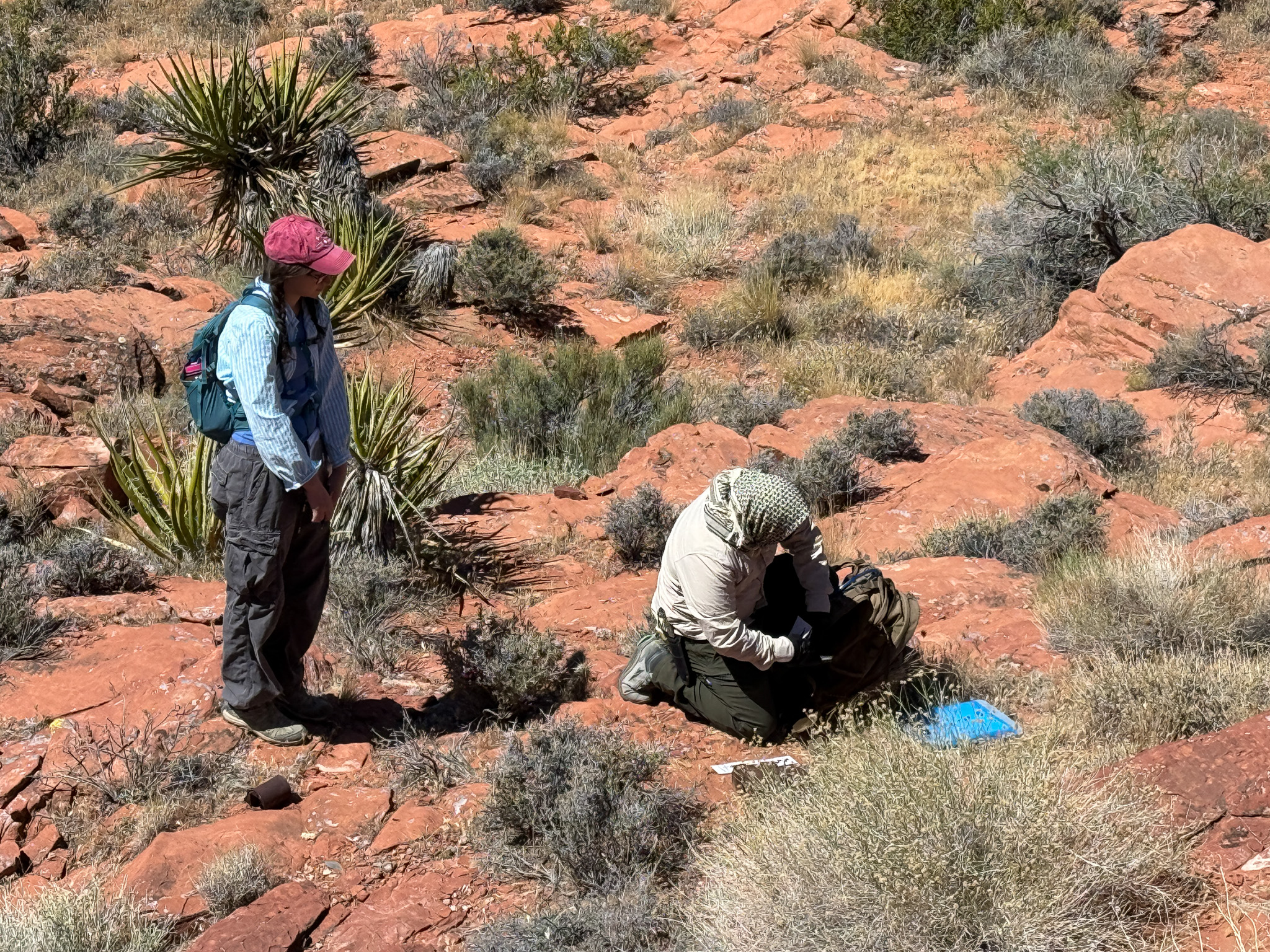
One of the most exciting parts of the project has been working with three undergraduate students from UNLV. These students have jumped headfirst into the world of cultural preservation, helping with photography, digital file management, and detailed illustration work. They’re not just observing—they’re gaining real-world field experience that will shape the next generation of preservation professionals.
And there’s a lot to learn out there.
Students are developing skills in relocating glyphs in the field, understanding how lighting can completely change the visibility of rock writing, and mastering programs like Photoshop and Adobe Illustrator to create accurate digital illustrations. Every image and drawing becomes part of a permanent record that researchers and future generations can rely on.
Past collaborations with J. H. N. Loubser PhD, RPA at Stratum Unlimited LLC taught NVFCP an important lesson: high-resolution photography and accurate illustrations matter. A lot. Tiny details can disappear over time, and once they’re gone, they’re gone forever.
That reality hit hard during our May documentation outings.
Sadly, we discovered that several pictographs and petroglyphs have completely eroded since earlier recordings. In some cases, the previous photographs and illustrations are now the only visual evidence that these images ever existed. It was a sobering reminder of how fragile cultural resources can be—and how urgent this work truly is.
To tackle some of the more difficult recording challenges, NVFCP has also been using drone technology. Drones allow us to safely document higher glyphs and massive horizontal panels that would otherwise be difficult to photograph accurately from the ground. Plus, seeing ancient rock art from above offers an entirely new perspective on how these panels interact with the surrounding landscape.
Despite the challenges, every day in the field has reinforced why this work matters. Preservation is more than documentation—it’s storytelling, stewardship, and creating a bridge between the past and the future.
At Little Red Rock, those stories are still written on the stone. And thanks to dedicated partners, students, and evolving technology, we’re doing everything we can to make sure they’re not lost to time.
Photo: Intern learning how to document historic cans from Knight and Leavitt Associate crew member
Showing 1 reaction